
The debate of adhesive remover spray vs wipes is one of the most common considerations among ostomy and wound care users. Both formats are designed to loosen adhesive and improve comfort during appliance or dressing removal, but they work differently and suit different situations.
Discussion across ostomy communities regularly shows users comparing sprays and wipes based on a number of factors like skin sensitivity and how they fit into daily routines. Guidance from Oakmed also notes that sprays are often preferred for broad application, while wipes can be easier for some users with dexterity limitations.
Safe n’ Simple offers both approaches. This makes side-by-side comparison easier. Its product range includes an alcohol-free adhesive remover spray, alcohol-free wipes, and alcohol-based wipes designed for heavier residue.
There is no universal winner. Many experienced ostomates use both formats together: Spray to help release the appliance edge and wipes to clean remaining adhesive from the skin. The right choice often depends less on the product itself and more on when and how it is being used.
How Adhesive Remover Sprays Work
Adhesive remover sprays work by delivering a fine mist directly along the edge of the adhesive barrier. The liquid penetrates beneath the appliance or dressing and helps break down the adhesive bond while the user gradually removes the product.
A common technique described in ostomy guidance is a spray-peel-spray approach: spray the edge, peel a small section, spray again, and continue slowly. This creates a controlled release rather than pulling the appliance away all at once.
Sprays also differ from wipes in how they interact with the skin:
- Applied without direct contact from an applicator
- Cover larger adhesive areas quickly
- Can be used continuously during removal
- Often dry rapidly after use
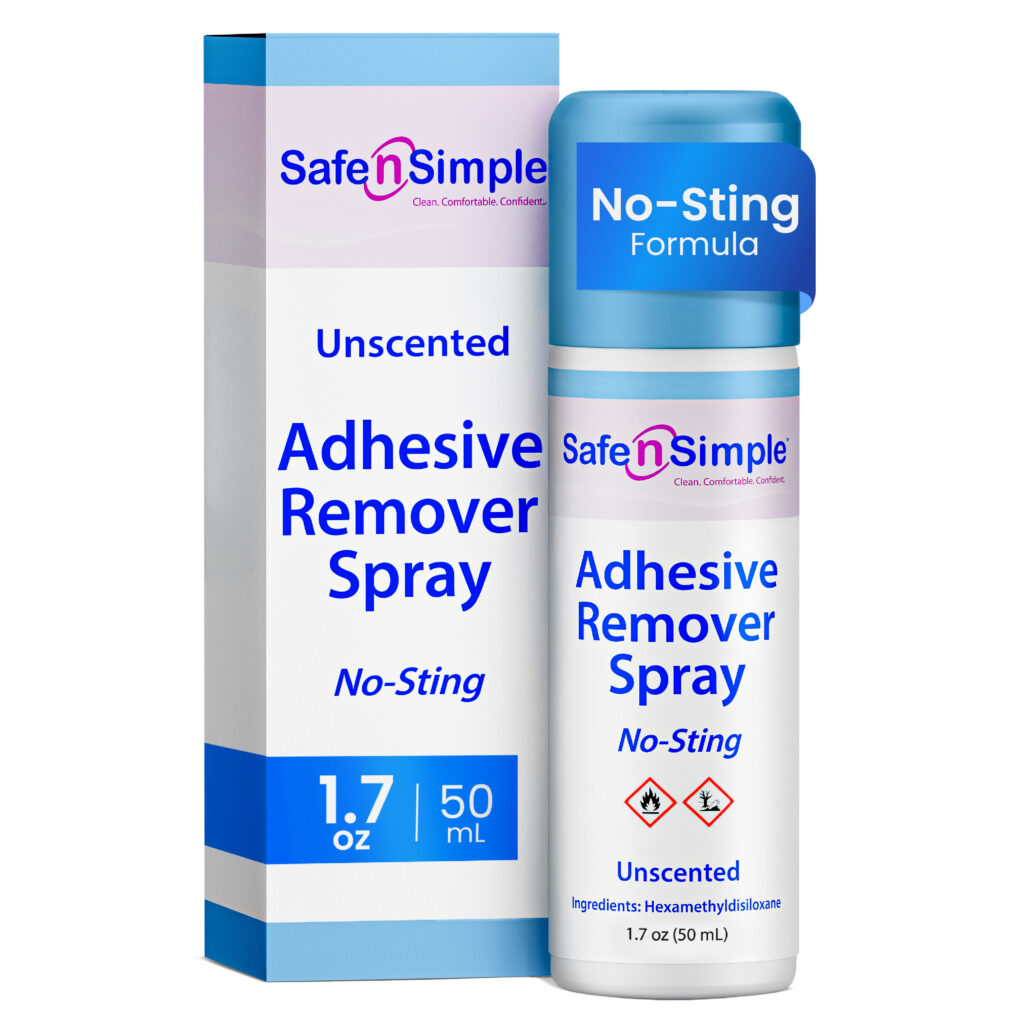
Safe n’ Simple’s Adhesive Remover Spray without Alcohol follows this approach. It is designed to be sprayed along the wafer edge. After a few seconds it facilitates gradual removal. The alcohol-free formula is designed to leave no oily residue and does not require rinsing.
How Adhesive Remover Wipes Work
Wipes use a different approach. The adhesive-removing solution is contained within a pre-saturated cloth applied directly to the skin and adhesive surface.
The key difference is that wipes combine two actions:
- Chemical loosening of adhesive
- Gentle physical wiping to lift residue
This can make wipes especially useful after an appliance has already been removed and adhesive remains on the skin.
Safe n’ Simple includes two different wipe approaches:
Peri-Stoma Cleanser & Adhesive Remover Wipes (alcohol-free) — designed as a dual-purpose wipe for cleansing skin and removing adhesive residue at the same time
Adhesive Remover Wipes with Alcohol — formulated for stronger removal of heavier adhesive buildup or stubborn residue
Wipes often provide more direct control over small areas and cleanup tasks. They are often easily portable and convenient for users.
Spray vs Wipes — Head-to-Head Comparison
This is where the adhesive remover spray versus wipes debate becomes more practical. Both remove adhesive effectively in the right scenario. But they do it differently and often suit different stages of appliance removal.
| Feature | Spray | Wipes |
| Ease of application | One-handed point-and-spray application. Helpful for hard-to-reach areas. | Usually involves gripping and wiping directly. Wipes may feel easier for some users with dexterity limitations. |
| Precision & coverage | Targets adhesive edges and covers larger areas quickly. | Better for spot-cleaning residue. Large wipes cover broader skin areas. |
| Residue | Alcohol-free sprays are designed to dry without oily residue. | Alcohol-free wipes also leave skin ready for the next appliance. Alcohol-based versions require rinsing. |
| Portability | Compact bottle but still a liquid product and not easy to transport. | Individual packets fit easily into bags or pockets. |
| Hygiene | No-touch application. | Single-use format with a fresh wipe each time. |
| Cost efficiency | One bottle often provides many applications. | Multiple wipes may be needed during one appliance change. |
| Best use case | Releasing the appliance edge during removal. | Cleaning adhesive residue after removal. |
Which Format Is Right for You?
The best option usually depends on routine, skin needs, and how appliances are changed.
Choose a spray if:
- You change ostomy appliances regularly
- You prefer one-handed application
- You want precise application at the wafer edge
- You have fragile or sensitive skin
- You want a lower cost per use
Safe n’ Simple’s Adhesive Remover Spray without Alcohol is ideal for this use case.
Choose alcohol-free wipes if:
- You want cleansing and adhesive removal together
- You travel often
- A caregiver assists with changes
- You have dexterity challenges
Safe n’ Simple Peri-Stoma Cleanser & Adhesive Remover Wipes combine cleansing and residue removal for a simple and portable use case.
Choose alcohol-based wipes if:
- Adhesive buildup is heavy
- Hydrocolloid barriers tend to leave stubborn residue
- Stronger removal is needed
Safe n’ Simple Adhesive Remover Wipes with Alcohol are intended for more difficult residue.
Use a combination of both if:
- You prefer a more complete removal routine
- You release with spray and clean with wipes afterward
That combined approach is one of the most common routines shared by experienced ostomy users.
Alcohol-Free vs Alcohol-Based — Does It Matter?
The comparison is not only about remover spray versus wipes. The formula itself also changes how a product behaves. Here’s a simple comparison.
Alcohol-free products:
- No sting
- No rinsing required
- Less drying with frequent use
- Suitable for routine daily use
Alcohol-based products:
- Have a stronger dissolving action
- Can sting sensitive skin
- May dry skin with repeated use
- Usually require rinsing afterward
Wound care recommendations and skin injury prevention guidance generally support alcohol-free products for routine use and vulnerable skin. Alcohol-based options still have a role when adhesive buildup becomes difficult to remove.
Safe n’ Simple offers both approaches. Users can choose based on the situation rather than relying on one product for every use.
Tips for Getting the Best Results
Technique matters as much as product choice. Many wound care and ostomy recommendations support a low and slow removal method rather than pulling appliances away quickly.
Helpful reminders and tips:
- Remove appliances gradually rather than pulling firmly
- For sprays, hold the bottle around 2–3 inches from the skin and apply along the adhesive edge while peeling
- For wipes, use smooth strokes in one direction rather than scrubbing back and forth
- Remove all adhesive residue before applying a new barrier
- If using alcohol-based wipes, rinse and dry the skin before applying the next appliance
- Store spray bottles upright and keep wipe packets sealed between uses
Safe n’ Simple products also include HCPCS coding that may support reimbursement:
- A4455 — Adhesive remover spray
- A4456 — Adhesive remover wipes
Coverage can vary. Users should check individual insurance arrangements.
When to Consult a Healthcare Professional
Adhesive removers can improve comfort, but they do not solve every skin issue.
Speak with a healthcare professional or WOC nurse if:
- Skin injury develops despite using adhesive removers
- Irritation or possible allergic reactions continue
- You are unsure which remover type suits your routine
- Appliance leakage keeps recurring
Repeated leakage may indicate a fit issue rather than a problem with the remover itself. Always consult a healthcare professional if you are worried about any symptoms.
FAQ
Neither is better in every situation. Spray is useful for releasing the appliance, while wipes are often better for cleaning leftover adhesive.
Yes. Many ostomates use spray to loosen the appliance and wipes afterward to remove remaining residue.
Wipes are generally easier for travel because they are compact. They are also individually packed and do not count as liquids for airline travel.
Alcohol-free wipes suit routine use and sensitive skin, while alcohol-based wipes are better for stubborn adhesive buildup.
Most alcohol-free formulas are designed to leave little or no residue. Alcohol-based wipes usually require rinsing afterward.
Spray is often more economical per use because one bottle can provide many applications.
Wipes may feel simpler for some people with limited dexterity. One-handed spray use can also potentially be helpful during appliance removal.